
How to Get Court Records
Utah Courts Xchange is the place to begin when you want to find a public state case, read Case History, or buy an available public image. If you're a party, MyCase gives access to your linked case and its filed papers. When the Summit County court record you need isn't there, send a specific written request to the clerk of the court that created it.
Which clerk? It depends on the case. The Clerk of Court for Utah Third District Court at the Summit County location holds most general civil, domestic, probate, felony, and Class A misdemeanor files. The Summit County Justice Court clerk keeps Class B and C misdemeanors, infractions, traffic cases, ordinance matters, and small claims. Juvenile Court staff control juvenile files, which are generally nonpublic. Federal cases live in PACER, not Xchange.
- Identify the court, Summit County location, case number, case type, and party role.
- Decide whether the need is inspection, a plain copy, certified copy, exemplified copy, recording, or transcript.
- Check Xchange or MyCase, or use a courthouse public terminal where available.
- Submit the written Utah Judiciary request when the online view does not supply the needed record.
- Arrange any search, staff, copy, certification, media, or delivery fee with the receiving court.
At the counter, ask the right clerk about inspection or a permitted copy. Call or email? Clarify the product before paying. Third District uses 435-615-4300, while Summit County Justice Court publishes 435-615-3800 and jcsummit@utcourts.gov. Mail, fax, email, and drop-box delivery follow current court instructions. One limit matters. Xchange records are never faxed or emailed.
Summit Court Record Request Form
Want a Utah Judiciary record? The Request for Court Record form is the proper written route. Describe the record with reasonable specificity, give your contact details, and choose inspection or copies. The form also covers fee-waiver grounds. Expedited treatment under Rule 4-202.06 appears there. So does proof that you're entitled to a nonpublic record.
That official page explains the request instructions. It also covers the channel distinctions that apply to Summit County court records. Review the Utah Courts request source.
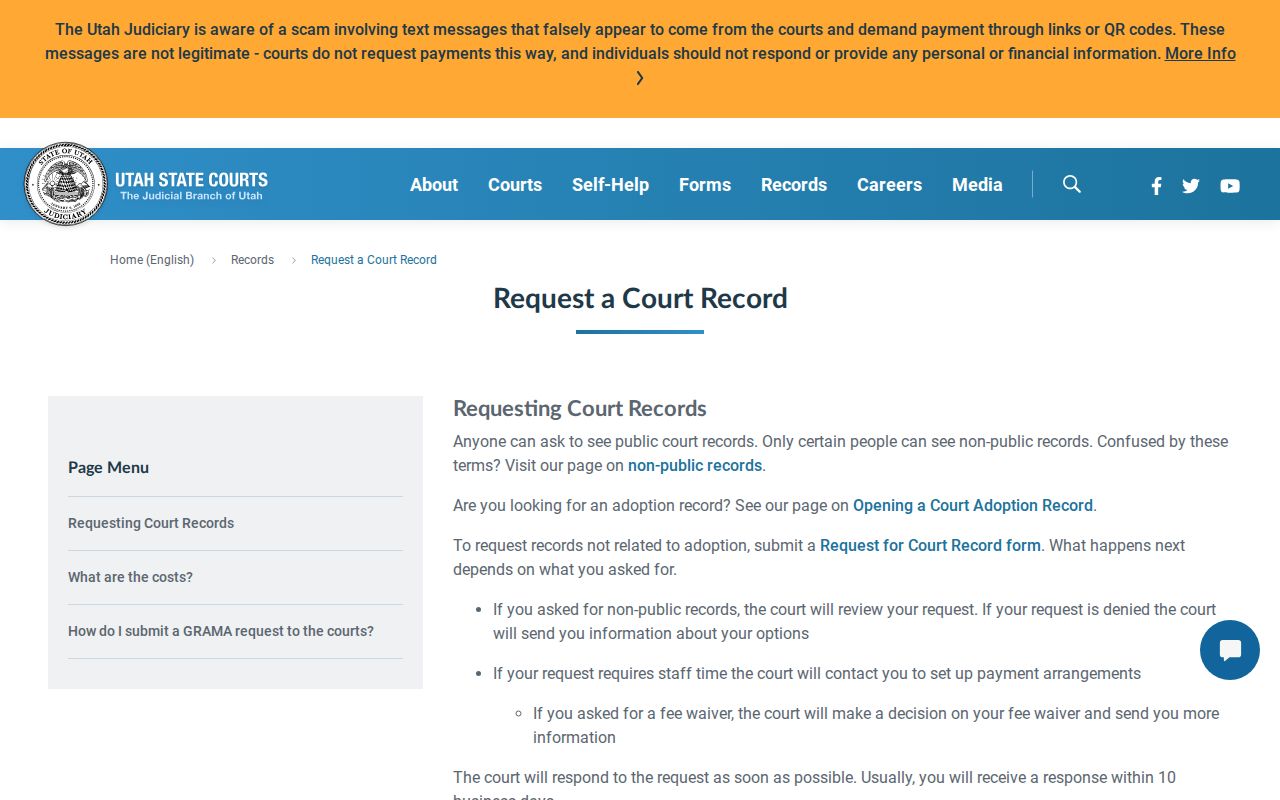
Describe what you want precisely. Name the court, location, case number, case type, filing or hearing date, and the exact document. That detail lets the clerk find the record fast and trims avoidable staff-search charges.
Types of Court Records
A Summit County court record can be several different products. The search index just locates the case. Case History is the dated chronology of events. A filed document is the real thing: complaint, petition, answer, motion, order, decree, judgment, letter, or exhibit, if public and available. Audio or video captures what was said at a hearing. Certification adds the clerk's authentication to a copy.
- Search-index results and Case History or Extended Case History
- Public pleadings, motions, exhibits, orders, decrees, and judgments
- Probate letters and other public appointment records
- Digital audio or video recordings and official transcripts
- Plain, certified, or exemplified copies made through the clerk
These layers don't swap. A free public history is not a certified record. A docket entry about a hearing is not the spoken record, and an image bought on Xchange carries no clerk certification just because of where it came from.
Summit Xchange Images and History
Utah Courts' Xchange overview covers public District Court documents. Those electronically filed since July 1, 2010 are electronically available as public access permits. The repository's reach goes back further. It generally covers District Court records from CORIS adoption, mostly by the end of 1998. Justice Court coverage varies. Older converted files can be sparse.
Pricing is simple: $1 per document, no matter the page count. A Purchase link tells you that specific image is there. That's all it tells you, though. It doesn't promise a complete case file, a private attachment, or a certified copy. Sealed, expunged, and confidential categories stay out of ordinary public results.
Quick check: Read the case history first. If the exact public paper has no purchase link, request that named document from the court clerk rather than repeating broad searches.
What a Court Record Contains
What you see depends on the layer. A Summit County search result names the case. The history lists procedural events, the file may hold the papers behind them, and a recording or transcript captures the spoken proceedings through a separate process.
| Case number and type | Identify the file within its court context; the number is not unique statewide. |
|---|---|
| Parties and role codes | Show names as entered and roles such as plaintiff, defendant, petitioner, or respondent. |
| Case events | List dated filings, proceedings, hearings, outcomes, and other entries. |
| Filed papers | May include public pleadings, motions, orders, decrees, judgments, and exhibits. |
| Document status | Indicates availability or classification; a public event can coexist with a private filing. |
| Recording or transcript | Preserves the hearing in audio/video or an assigned transcriber's written form. |
Read the later entries closely. A filed motion is a request, not a ruling. A hearing on the calendar doesn't prove it happened. Read any order or judgment by date, in context, alongside later modifications, appeals, or final outcome.
Summit Hearing Record or Transcript
Utah courtrooms record hearings by audio and video. That recording lives apart from the written Summit County court docket. The docket shows entries. The sound of the hearing is its own record. If you need what was said out loud, ask the judicial services representative for the recording. You can also start the official transcript process. A transcriber assigned to the case takes payment first and then produces the official transcript.
The Utah Judiciary lays out its own route. It runs from digital recordings to transcripts on the official page. Open the Utah Courts transcript source.
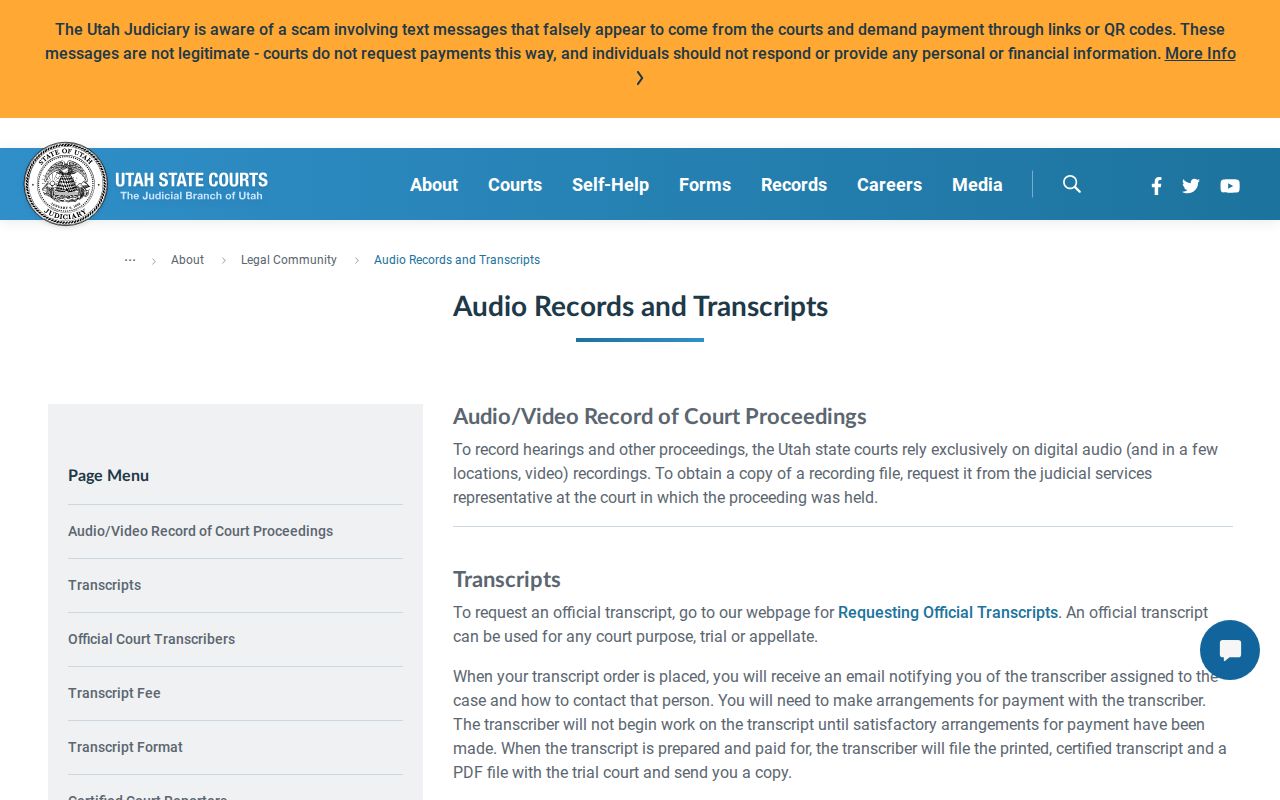
Why does this matter? An unofficial transcript can't serve in court as the official one. Asking only for "the docket" may get you just the event list. That's not hearing audio. It's not a certified written transcript.
Note: Confirm the hearing date, court, judge or team, and case number. Do this before ordering a recording or transcript.
Certified Copies and Fees
Three copy types exist. A plain copy just reproduces the record. A certified copy carries the clerk's seal. An exemplified copy adds an even higher layer of authentication. Check with whoever will receive the document before ordering, since they decide which form counts. Utah's fee schedule shows an effective date of May 6, 2026, so confirm current rates when you make the request.
| Item | Published amount |
|---|---|
| Paper copy | $0.25 per sheet |
| Certified copy | $4 per document plus $0.50 per page |
| Exemplified copy | $6 per document plus $0.50 per page |
| Electronic audio/video | $15 per half-day of testimony |
| Storage media | $15 per unit |
| Actual mailing cost |
Fax or email delivery runs $5 for the first ten pages. Each page past that adds $0.50. Records already available on Xchange are exempt from fax or email sending. Staff time is free for the first 15 minutes. Then it is billed by the hour. Those hourly rates depend on staff classification. UCJA Rule 4-202.08 spells out the fees, waivers, and access charges.
Third District Court, Summit County
6300 North Silver Creek Drive
Park City, UT 84098
435-615-4300
Summit County Justice Court
Confirm the current Paintbrush Road address before travel
Park City, UT 84098
435-615-3800
Specific Summit Court Record Requests
Plan on up to ten business days for a written Utah court-record response. Nonpublic-record review can stretch that window. The Summit court makes no promise of same-day certified copies. Build the wait into your plans. Name the exact document and the format you want. Then let the court set the fee and delivery terms.
The records request form lets you inspect without copy charges or order copies for a fee. Waiver grounds include certain government uses, an impecunious record subject with an affidavit, student academic research, and limited government requests. Want the expedited checkbox? The rule requires a public-benefit or media-style basis, not just personal urgency.
Skip the open-ended demand for every record tied to a name. If you know the case number and filing date, use them. Broad wording slows the search. It also piles on staff time. A focused request lets the clerk sort out a document from a recording, transcript, or certified copy.
Summit Court Clerk or Recorder
The Summit County Clerk is an elected county officer. That office does not keep the Third District Court docket. Deeds, plats, and land records belong to the Summit County Recorder, while court case files stay with the state or justice court clerk that created them. Remember the split when a property dispute spawns both a lawsuit and a recorded land document. Each paper lives in a different office.
| Record sought | Correct records door |
|---|---|
| District civil, criminal, domestic, or probate case | Third District Court clerk and Xchange |
| Justice traffic, misdemeanor, infraction, or small claim | Summit County Justice Court clerk and Xchange |
| Deed, plat, or recorded land instrument | Summit County Recorder |
| County or city administrative record | Relevant government office under GRAMA |
| Federal civil or criminal case | District of Utah clerk and PACER |
The county document portal is one thing. Utah Courts Xchange is another, and the first cannot replace the second. PACER handles federal dockets, including Summit County matters in the District of Utah's Central Division, but it never searches state trial-court records.
Public Access and Sealed Records
Utah court access runs on Utah Code and Judicial Council rules. A county GRAMA request is not the vehicle. UCJA Rule 4-202.02 sorts court records into classes, and Rule 4-202.03 sets who can reach public, private, protected, sealed, and expunged files. Any member of the public can request a public Summit County court record. Even so, other limits apply. Classification, redaction, and format still control what gets released.
Sealed and expunged cases never show up in ordinary Xchange results. Juvenile, adoption, civil mental-health, child-welfare, and termination cases sit outside ordinary public search. Certain nonpublic criminal categories do too. A civil case history can stay public while one attached paper stays private. A blank result can mean many things. It may reflect a court's choice, a spelling error, older coverage, or record classification. It does not prove the case never existed.
The Utah Courts nonpublic guide covers safe redaction and substitute values. Think the last four digits of certain numbers. Month and year of birth also works, as do a minor's initials. Public access is not a license to republish protected personal details.
Key rules: Request a public record from the court that maintains it. For a nonpublic record, use the official form's entitlement section and provide required proof. Delivery method never expands the right of access.
Found the case? The Summit County case search process helps you confirm the court, case type, case number, and filing date before you send a record request.