
How to Search Civil Dockets
Utah Courts Xchange is the main public search for Summit County civil court dockets. It covers District and Justice Court. Choose District for most general civil, domestic, probate, and related matters. Choose Justice for a small claim filed in Summit County Justice Court. Search by party or business name. Case number, case type, county, court location, and date range work too. Xchange searches are billable. Narrowing the scope before you press Search can trim needless charges.
Work from the details on a notice or filed paper. Names vary by spelling, former name, business style, or abbreviation. Xchange matches names exactly unless a documented wildcard is added. A case number is more direct. But Utah case numbers are not unique statewide. Pair it with Summit County, the correct court, or the case type.
- Choose District, Justice, or both based on the kind of civil case.
- Set the search scope to Summit County or the known court location.
- Enter a party name, company name, or case number, then add a case type or date range.
- Confirm the county, court location, filing date, and case type in the results.
- Open Case History/Documents and read the events from oldest to newest.
Other channels matter too. A party can use MyCase for linked filings, payments, notices, and the next appearance. Public Xchange terminals sit at most District Court sites, and the State Law Library offers free Xchange access. The Third District Court line is 435-615-4300. Summit County Justice Court uses 435-615-3800. Written requests follow the receiving court's current mail, fax, email, or drop-box instructions, though Xchange documents themselves are not faxed or emailed.
Summit Civil Xchange Case Types
Start with the case type whenever you read a Summit County civil docket. The label shows what kind of dispute you face. Contract and debt matters sit apart from domestic, probate, civil stalking, and protective-order cases. Each type carries its own set of roles and events. The official Xchange case-type table gives you the exact labels Utah Courts uses. Check that label before you draw any conclusion about a party or a filing.
A case-type code can look like clutter at first glance. It is not. In a docket search, that one field often explains why a case exists. It also hints at what each entry will do.
View the Utah Courts case-type table. It lists every code the Summit County civil docket draws on.
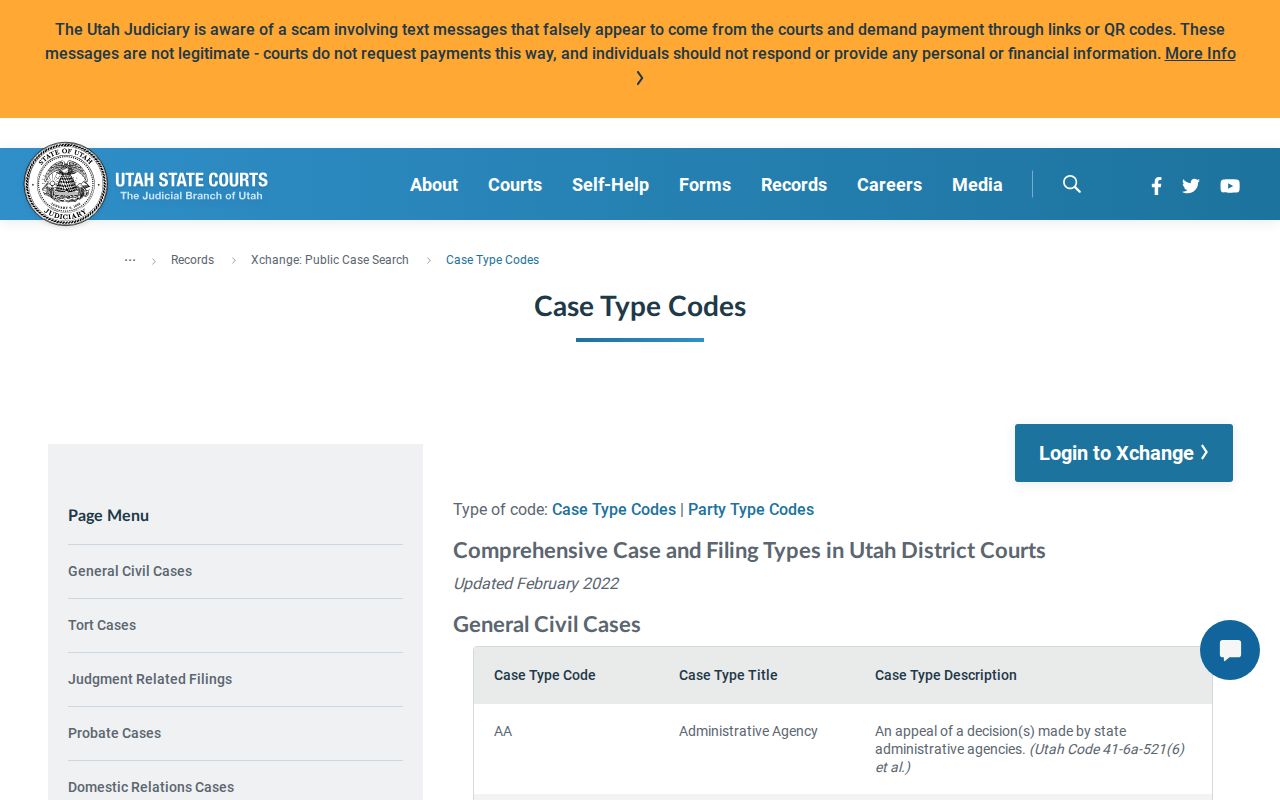
The code list helps a reader narrow a Summit County docket search without treating every civil matter as the same kind of lawsuit.
What a Civil Docket Shows
Utah labels the docket-like chronology Case History. You may also see Extended Case History. A Summit County civil court docket result opens with identifying fields. It then links to dated proceedings and any public images for purchase. The chronology may show the complaint or petition, later motions, hearings, orders, judgments, decrees, and letters of appointment. An outcome or status can appear too. A line only shows that an event was entered. By itself, it does not prove a claim true or a requested order granted.
| County and court | Identifies where the Summit County civil case is held and which clerk keeps it. |
|---|---|
| Case type | Distinguishes general civil, domestic, probate, small claims, or another court category. |
| Case number | Identifies the file in its court context; the first two digits generally indicate the filing year. |
| Party and code | Shows an entered name and a role such as PLA, DEF, PET, or RES. |
| Filing date | Shows the recorded opening date, not the date of each later event. |
| Case History | Opens the dated civil docket sequence and document links when available. |
Don't guess at a role you don't recognize. The official party-code table sorts out what each label means. Note that plaintiff and petitioner are not interchangeable across case types, and the same goes for probate roles like guardian, conservator, or heir.
Summit Civil Docket Volume
The official FY2023 Summit District report offers a scale check. It lists 428 general-civil filings. Dispositions total 383. Debt collection accounted for 231 filings; contracts accounted for 91. The same report lists 206 domestic filings, 105 probate filings, and 1,273 judgment filings. These are court workload counts. They are not counts of unique people, and they do not say which side prevailed.
A disposition total can include cases filed before the fiscal year. That explains why some categories show more dispositions than new filings. The rate is not a win rate. It should not be used to predict a result in any Summit County civil case.
Note: Fiscal-year statistics describe court workload. A civil docket documents the events in one specific case.
Types of Civil Cases
Most Summit County general civil, domestic, and probate matters are kept by the Clerk of Court for Utah Third District Court. Summit County Justice Court keeps its small-claims docket. Each category takes a different reading habit, because a public entry may describe a dispute, an estate step, or a family-court order without making every supporting paper public.
| Category | Likely court | What to check |
|---|---|---|
| Contract, tort, property, debt | Third District Court | Case type, parties, filings, orders, and judgment entries |
| Divorce or custody/support | Third District Court | Public history plus document-level privacy limits |
| Probate or guardianship | Third District Court | Orders, decrees, appointments, and role codes |
| Small claims | Summit County Justice Court | Current limit, setting, judgment, and any District Court appeal |
| Protective order or civil stalking | Case-specific | Public status and safety-related access limits |
The county Justice Court page still states a $15,000 small-claims limit. Newer statewide materials point to a $20,000 framework. Since the official sources conflict, confirm the current limit with Utah Courts or the issuing court for the filing date.
Summit Civil History and Documents
A visible Summit County civil docket does not guarantee access to every attachment. Utah Courts explains that some civil-action documents have been private. That privacy dates to April 1, 2012. Public case history may still be visible. So may hearings, judgments, orders, decrees, and letters of appointment. The privacy rules can affect domestic, paternity, custody, protective-order, civil-stalking, guardianship, conservatorship, and related categories.
Key distinction: A public Case History line reports a procedural event. A purchase link is document-specific, and no link appears merely because the event itself is public.
If an attachment is not downloadable, first check its classification. Then identify the exact item and use the court-record request path if access is permitted. Do not assume that payment turns a private filing into a public one.
Settings on Summit Civil Dockets
A setting on a Summit County civil court docket means the court scheduled an event, nothing more. It is not a result. The entry may list a hearing date or a proceeding, and the Utah Courts calendar gives a second view of what is coming up in District and Justice Court. MyCase, when a party is linked to the case, can show the next appearance too. Each tool answers a slightly different question, so check the current calendar against later Case History entries and anything the court mailed out.
Learn to tell the steps apart. A motion filing is a request. A hearing setting puts it on the schedule. A held proceeding means the court took it up. A signed order is the ruling. A reset moves the date, a continuance delays an event, and a vacated setting removes it entirely. Read together they tell a story, but no single one of them means the whole civil case was dismissed.
Filing → setting → hearing → order or judgment → disposition.
For more help with hearing dates, the Summit County court calendar reference is the place to look, and the clerk can confirm any change.
Summit Civil Docket or Recorder
A land dispute usually creates two separate public records, and they live in different offices. The civil case itself sits with the state court clerk. It shows up in Xchange when it is public. A deed, plat, lien recording, or other land instrument is a different animal. That belongs to the Summit County Recorder. One more wrinkle: the county Clerk handles county administration. It is not the clerk of Utah Third District Court.
| Needed record | Correct custodian |
|---|---|
| Civil complaint, motion, order, or judgment | Third District Court clerk |
| Justice Court small-claims file | Summit County Justice Court clerk |
| Recorded deed, plat, or land document | Summit County Recorder |
| County meeting or administrative record | Relevant county office under GRAMA |
Use the civil docket to see what the court received and how it ruled. Use Recorder records to see what was filed against the land. Neither system stands in for the other.
Hearings on Civil Dockets
When a Summit County civil docket lists a hearing, confirm the court level. Confirm the location too. Then confirm the judge or team, the time, and the type of hearing. The Silver Summit area houses District, Juvenile, and Justice functions. Those are separate dockets, so do not assume one entry covers them all. Follow the notice and whatever the court currently instructs, especially for a remote hearing. The Justice Court posts Webex-first instructions unless it says otherwise. But that is not a blanket remote rule for every Third District civil hearing.
A date that looks off? Compare the calendar. Check MyCase if the party can access it. Then read the most recent case-history entry before calling. After that, phone the right office, because Third District and Justice Court use different contact lines. The clerk can confirm administrative details. Court staff cannot hand you legal strategy, though. They cannot promise that a scheduled motion will be granted.
Public Access to Civil Dockets
Utah Code and the Utah Judicial Council's court-record rules govern access. The chief rules are UCJA Rule 4-202.02 on classification and Rule 4-202.03 on access. Anyone may ask for a public record, subject to classification, redaction, format, and lawful fees. GRAMA covers county and city government records. But it will not substitute for a Utah Judiciary court-record request.
Public, private, protected, sealed, and expunged are distinct classes. Juvenile, adoption, civil mental-health, sealed, expunged, and other nonpublic records stay private. No name search is broad enough to reach them. Someone with a rule-based right to a nonpublic item can use the entitlement section of the official request form. Supply whatever proof the court requires.
Access rule: Ask the court that created the record. Describe the Summit County civil docket, case number, date, and exact filing with reasonable detail, then state whether inspection or a copy is needed.
Need the full filing and not just the chronology? The Summit County court records process walks through plain, certified, exemplified, recording, and transcript routes.