
Searching Cases by Name
Utah Courts Xchange is the main public search. It covers Summit County District and Justice Court case information. A name lookup works best with exact spelling and a known jurisdiction. Xchange matches names exactly unless you use its documented wildcard. Enter the surname first, then the first name. If results flood in, narrow them. Add Summit County, a court, a case type, or a date range. Searching for a company? Put the name in the Last Name or Company field.
- Choose District, Justice, or both for the jurisdiction.
- Select all cases or judgments entered as the search type.
- Enter the last name or company and the first name when known.
- Limit the scope to Summit County or the correct court location.
- Add a case type or date range before pressing the billable Search button.
The official Xchange field instructions cover wildcards and the 500-result cap. Broad docket searches can burn several paid credits. Narrow first and save both time and repeat charges.
| Field | Input | Summit County use |
|---|---|---|
| Jurisdiction | District, Justice, or both | Match the court level |
| Search Type | All cases or judgments | Choose the event sought |
| Name | Last/company and first | Use a documented wildcard |
| Scope | Statewide, county, or court | Limit to Summit when apt |
| Date panel | Filing, disposition, judgment | Reduce common-name results |
Summit County Xchange Search Scope
Xchange is statewide, yet it can focus on Summit County or one court location. The Utah Third District Court holds Summit felony, Class A misdemeanor, general civil, domestic, and probate matters. Summit County Justice Court holds most Class B and C misdemeanors, traffic cases, infractions, ordinance matters, and its small claims. Juvenile records are generally outside public Xchange.
The official judicial district map places Summit County in the Third Judicial District. A statewide search can find same-name cases outside Summit County, but each result must be checked for county and court location. Federal matters require PACER. Utah eFiling is not a public lookup path.
The Xchange landing screen shows where the search starts.
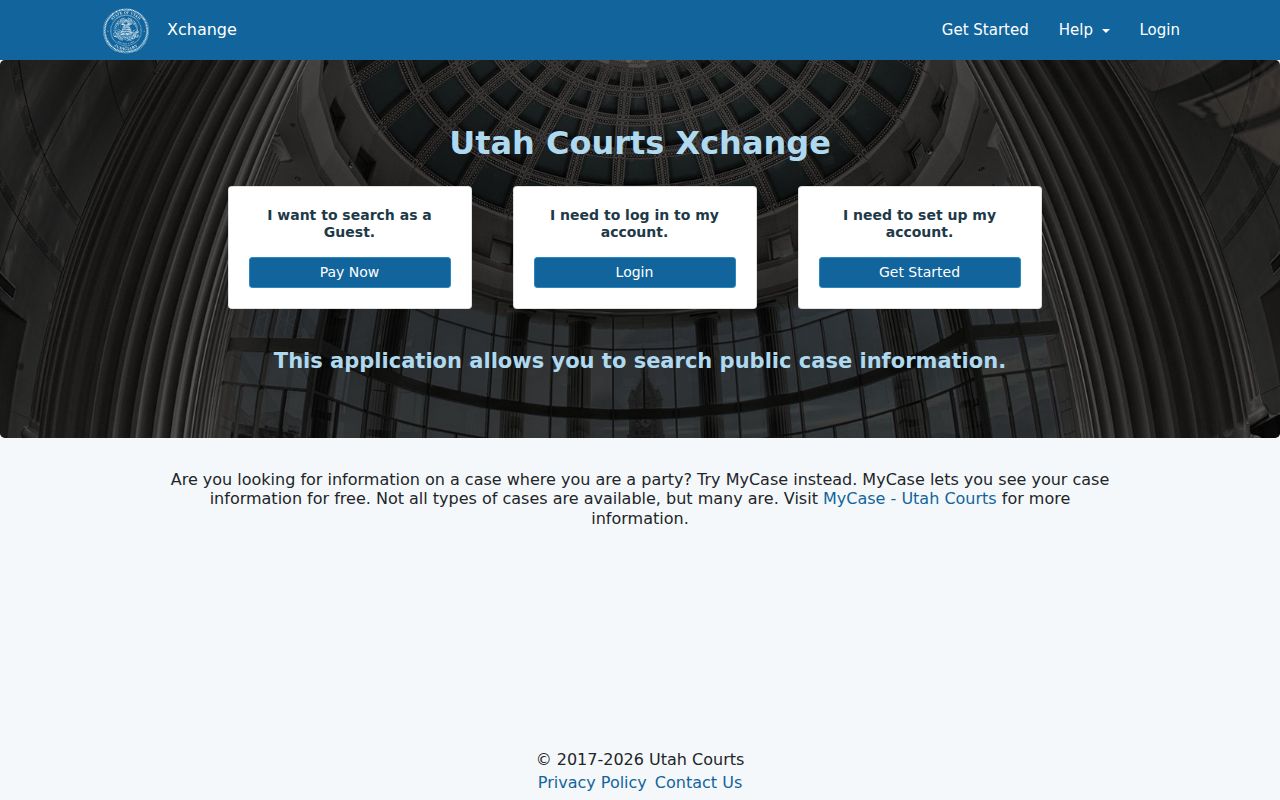
The state repository is the right first door for a Utah court case, not the Summit County government document portal. This screen makes that plain.
Searching by Case Number
Once the court is known, a case number is the cleanest lookup key. Utah guidance says the first two digits generally mark the filing year. The number is still not unique across the state. Pair something like 26XX00000 with Summit County, the Silver Summit location, jurisdiction, or case type. That generic pattern is not a live case.
When a number fails, check each character against a notice or filed paper. Then test the proper District or Justice scope. A federal format like 2:26-cv-00825 belongs in PACER. Still unsure of the court level? Call Third District Court at 435-615-4300 or Summit County Justice Court at 435-615-3800.
Always pair a Utah case number with its court. The number alone is not unique statewide.
Summit County Search Credits
Xchange offers subscriber access and a one-time guest path. The Search button is billable, so broad attempts followed by refinements can consume several credits. The subscription and guest instructions describe accounts, payment, searches, sessions, and document charges. A Purchase link is separate from the initial search.
The official guest registration route shows the fields required before a one-time search.
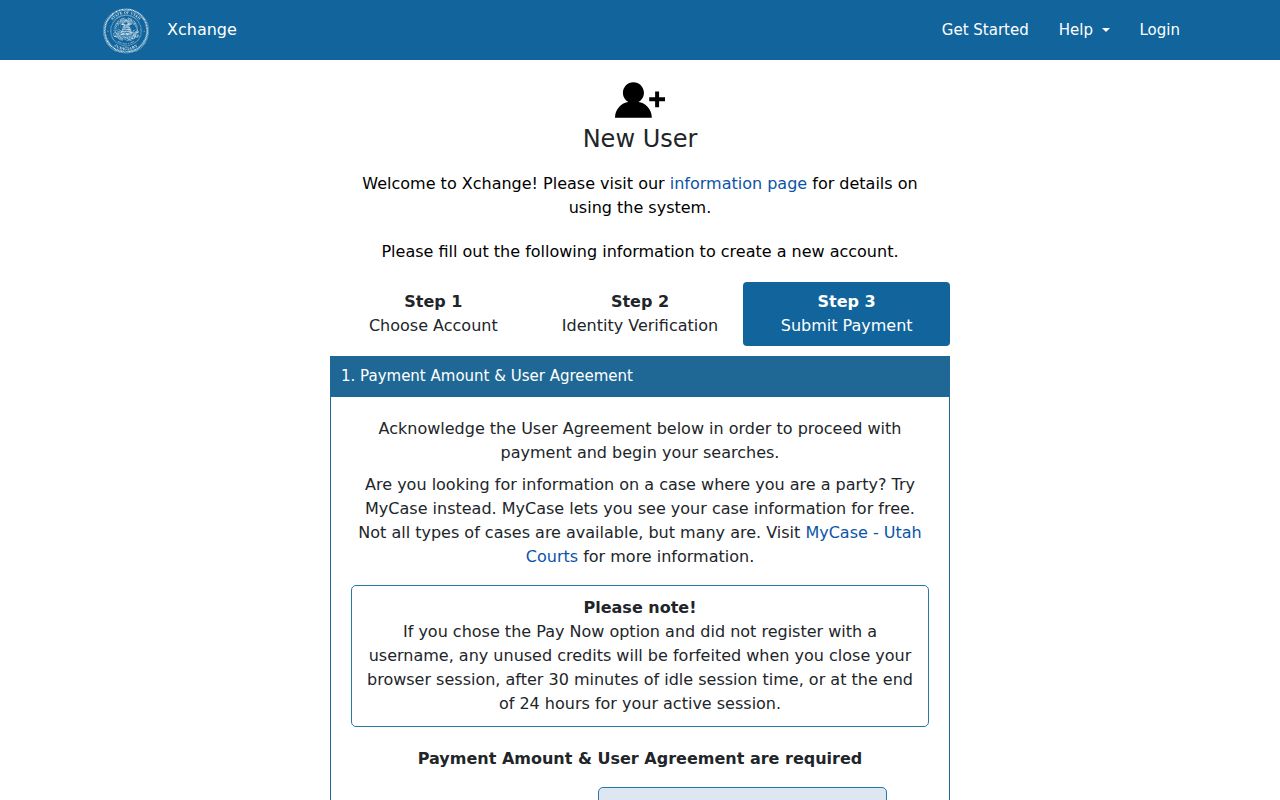
Registration details exist only to open a paid session. They form no part of a court docket, so leave them out of any case summary.
Plan first: Fix the court scope, spelling, case type, and likely filing period before spending a search credit.
What a Case Search Returns
The first result screen is an index, not the full file. Before opening Case History/Documents, confirm the basics. Check Summit County, the court location, case type, number, and filing date. Party codes describe roles. PLA means plaintiff, DEF means defendant, PET means petitioner, and RES means respondent. A role code does not establish what happened in the case.
| County and court | Shows where the case is held and separates similar names or numbers. |
|---|---|
| Case type | Identifies the system category, such as criminal, civil, probate, or traffic. |
| Case number | Links directly to the case in its court context. |
| Filing date | Marks the opening date, not each later event. |
| Party code | Labels a procedural role without deciding the case. |
| Case History | Opens proceedings, filings, hearings, judgments, and outcomes. |
A filing is not a ruling. A set hearing may never have occurred, and a charge is not a conviction. Read the later orders, pleas, and dispositions. The official party-code table beats guessing an abbreviation.
Summit Case History and Documents
Utah calls the docket timeline Case History or Extended Case History. It can show events and proceeding dates. Filings, hearings, judgments, orders, and outcomes appear too. Criminal extended history may add agency, citation, charge class, plea, disposition, and account fields. A birth date can appear in a criminal result. Do not republish it. The Xchange help view illustrates the scope controls and links used to reach the history.
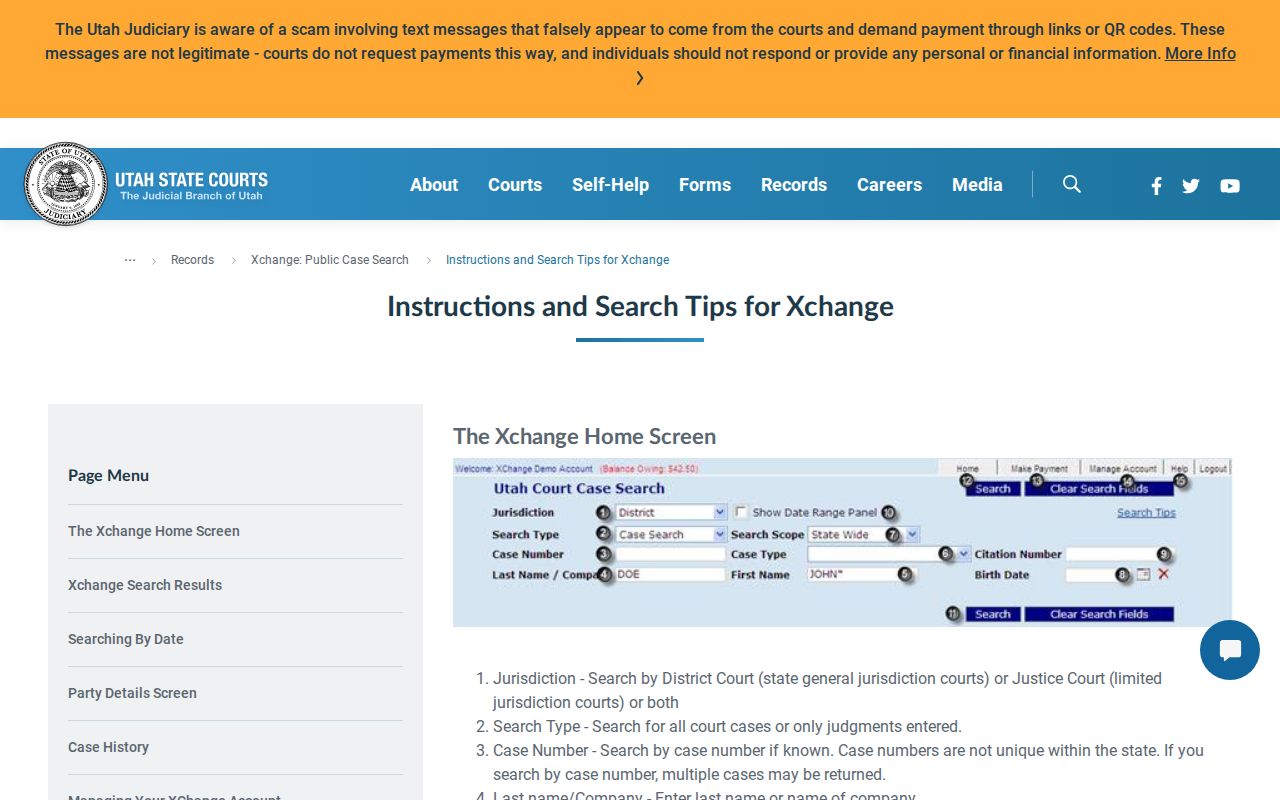
A Purchase link tells you one public document image exists. It promises nothing about every attachment being public, imaged, or certified. For an official copy, ask the right clerk.
Statewide vs County Case Search
There is no separate Summit County court database competing with Xchange. Xchange itself provides both the statewide and county-focused views. MyCase serves parties who link eligible cases. They can see filed papers, a next appearance, balances, and notices. The statewide calendar shows scheduled activity, not a full case history.
| Channel | Coverage | Best use |
|---|---|---|
| Xchange statewide | Public District and Justice records | County is uncertain |
| Xchange Summit | Results narrowed by county or court | Known local matter |
| MyCase | A party's linked cases | Own papers and notices |
| Public terminal | Free Xchange where available | In-person public access |
Public terminals sit at most District locations and some Justice locations. Call to confirm Summit Justice access. The State Law Library also offers free Xchange. A searcher can visit the clerk, call the court, or file a written request for a specific copy. Xchange records are not faxed or emailed.
Older Summit County Case Searches
Clerks type case data into CORIS, and Xchange carries it onward. District Court coverage reaches back to when each court adopted that system. Adoption was mostly complete by the end of 1998. Justice Court coverage varies. Older converted cases may show less detail. Since July 1, 2010, electronically filed District documents have broader electronic availability. Yet some docket event lines carry no image at all. A thin result is not the whole file. Ask the Summit County clerk about a reasonably specific request. Give the court, location, case number, case type, date, and document name. Retrieval, review, fees, and response time may all apply.
Access and Restricted Cases
Utah Code and Judicial Council Rules 4-202.02 through 4-202.08 govern access. Xchange omits sealed and expunged cases. Adoption, civil mental-health commitment, juvenile delinquency, child-welfare, termination matters, and designated nonpublic criminal categories never appear as ordinary public results. Some civil papers stay private. Even then, the public docket shows hearings, judgments, orders, or decrees. A blank result proves nothing. Filed cases can stay out of public view. Check the court, location, spelling, wildcard, type, and dates before giving up. Then weigh age or restricted status. A person with a rule-based right may use the nonpublic-entitlement part of the Request for Court Record form with proof. Mail, fax, email, or a visit never expands access rights.
Public access limit: Ask the correct clerk about the lawful path. Do not try to work around a seal or juvenile rule.
Search Summit Cases, Then Request
A good request begins with identifiers pulled from Xchange. Ask to inspect or copy one named item, not every file tied to a person. Direct the request to the court that holds the record. The Utah Judiciary wants reasonable specificity. It ordinarily answers within ten business days, though classification review can stretch that period. The official pricing page separates search-session charges from document purchases.
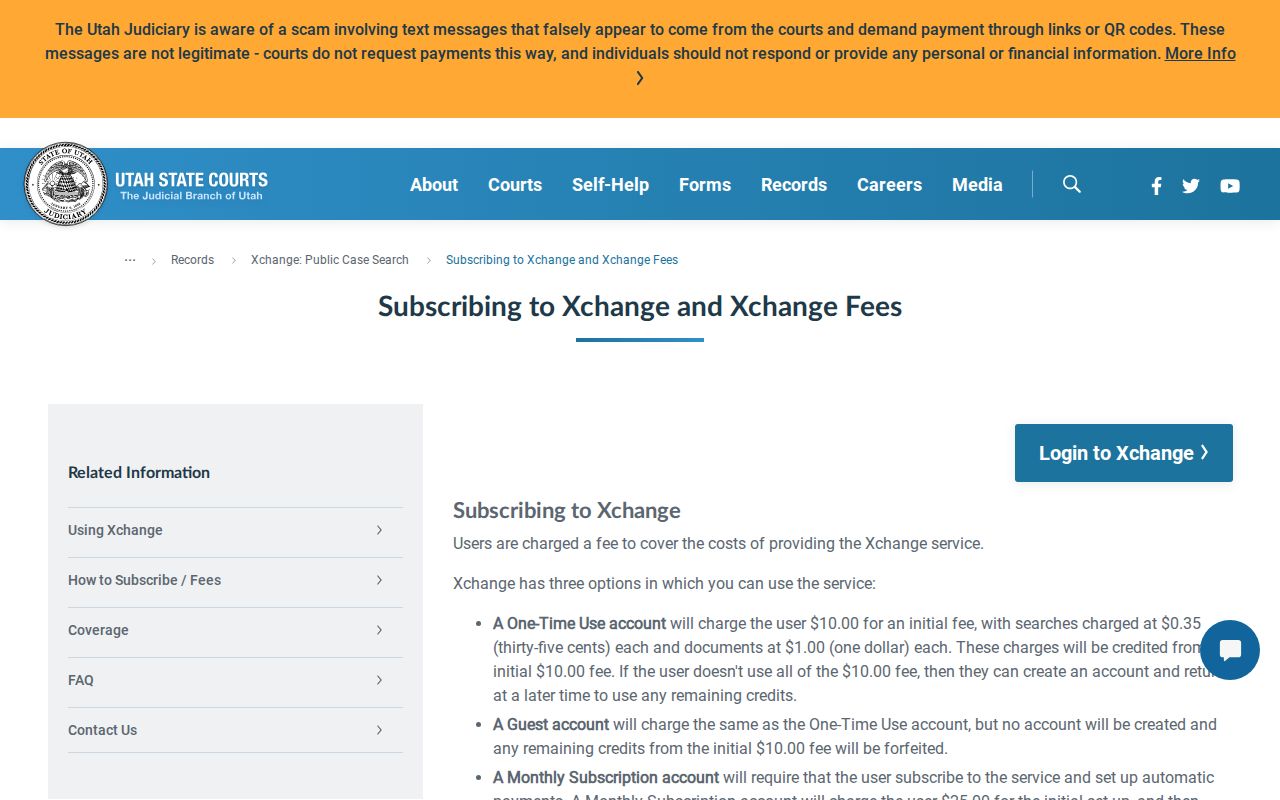
That split explains the gap. A Summit County docket entry can be visible while the paper itself needs a purchase or a clerk request, and the court records process for Summit County covers copies in more depth.
Refining Summit County Case Searches
A common name can flood a statewide result set. Limit the search to Summit County, pick District or Justice jurisdiction, and add the relevant case type or filing period. Check party role, location, and filing date first. An empty narrow query is not the last word. Remove one filter at a time, and try the documented wildcard or an alternate business spelling. That way you test the query without reading an empty screen as a fact about the case.
Correcting a Summit County Case Search
A Salt Lake or Tooele result can surface because all three counties sit in the Third Judicial District. That still does not make it a Summit case. Read the county and court-location fields, then rerun the search with Summit County selected. Justice appeals can move up to District Court, while federal and bankruptcy cases live in federal systems. Each level keeps its own record. The first result is not the whole path.
Summit County Cases in MyCase
Utah Courts MyCase serves parties who link their own eligible matters with identity and case details. It can show filed papers, a next appearance, balances, payments, and notices that a general public name search never returns. MyCase is no substitute for Xchange. Xchange, though, may miss some party-only papers. For following a public Summit County case, Xchange remains the better channel. Let your role in the case pick the tool.